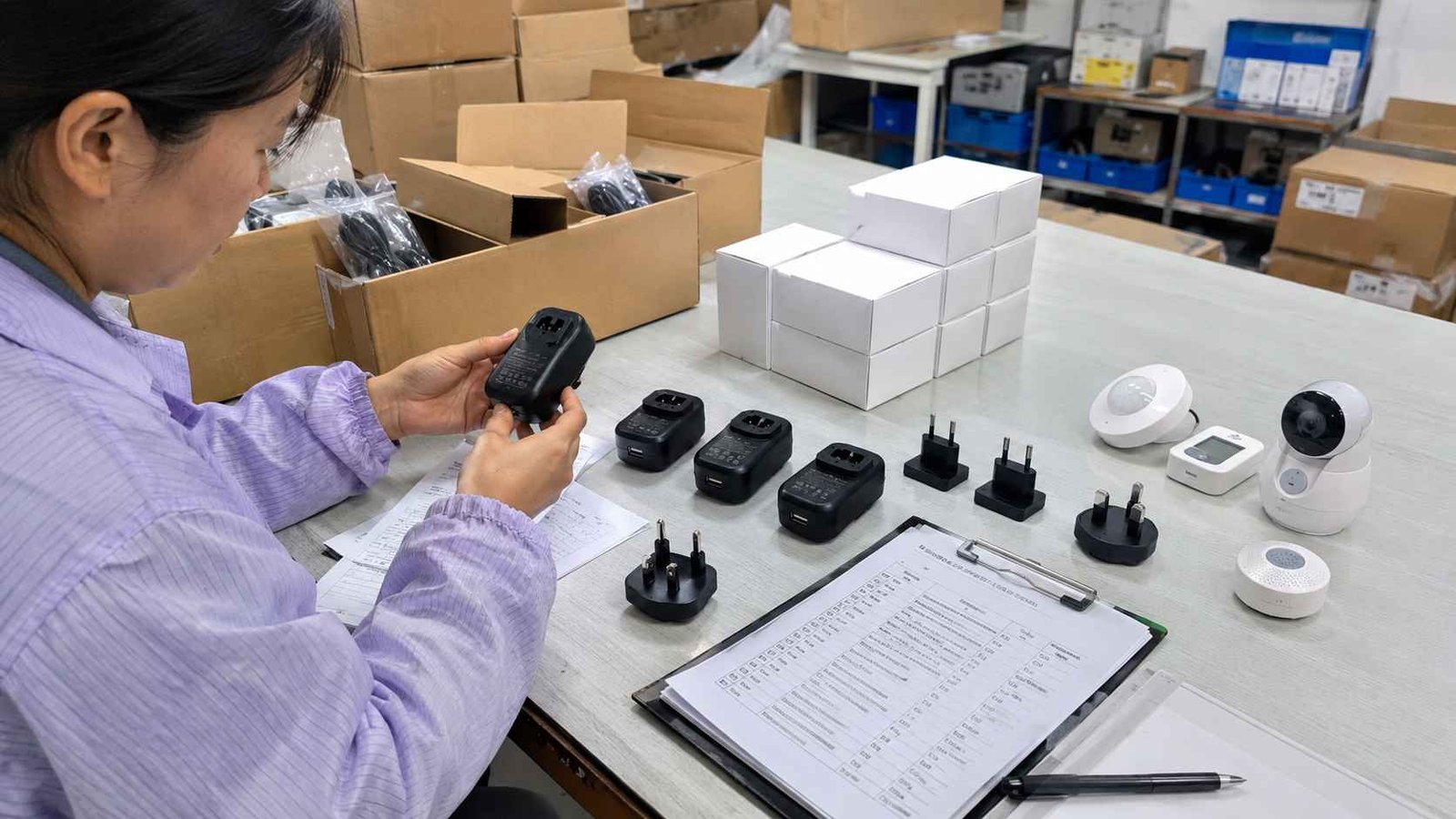


For small electronic devices exported to Europe, North America and other regulated markets, the power adapter is not just an accessory. It affects product compliance, standby power consumption, heat, user safety, packaging approval and after-sales stability. A low-voltage device may pass functional testing with a basic adapter, but it can still face problems if the adapter does not meet the target market’s energy efficiency, safety, plug, label or documentation requirements.
This is especially important for 3V, 5V and 6V export electronics such as smart sensors, small gateways, alarm accessories, embedded control boards, compact measuring devices, low-power consumer electronics and battery-replacement products. These devices are often left plugged in for long periods, so no-load power consumption, thermal behavior and certification documents should be checked before sample approval.
This guide explains how to choose a Level VI and EU Ecodesign-ready power adapter for 3V, 5V and 6V export electronics from a practical engineering and procurement perspective.

Table of Contents
- 1. Understand the difference between Level VI and EU Ecodesign
- 2. Why 3V, 5V and 6V adapters need careful selection
- 3. Confirm output voltage and current before choosing a model
- 4. Check active efficiency and no-load power consumption
- 5. Match the adapter to the real device application
- 6. Confirm connector, polarity and cable details
- 7. Match plug type and label requirements to the target market
- 8. Review safety, EMC and protection requirements
- 9. Check heat performance for 24/7 plugged-in devices
- 10. OEM/ODM details to confirm before sample approval
- 11. Common mistakes in export adapter selection
- 12. Final procurement checklist
- 13. FAQ
1. Understand the difference between Level VI and EU Ecodesign
Level VI is commonly associated with the U.S. Department of Energy efficiency requirements for external power supplies. It focuses on average active efficiency and no-load power consumption. For exporters, Level VI compliance is important when the adapter or final product is sold into the U.S. or other markets that recognize similar efficiency expectations.
The European Union does not usually describe its requirement simply as “Level VI.” The EU uses Ecodesign requirements for external power supplies, including limits on active efficiency and no-load power consumption. For export electronics, buyers should confirm the adapter’s compliance with the correct EU regulation, test report and declaration documents instead of relying only on a general “Level VI” statement.
In practical purchasing, this means the adapter should be checked from two angles:
- Efficiency marking and test data — whether the adapter meets the required active efficiency and no-load consumption level.
- Market compliance documents — whether the supplier can provide the correct documents for the destination market, such as EU, U.S., UK or other regional requirements.
2. Why 3V, 5V and 6V adapters need careful selection
Low-voltage adapters are often used with small devices, but this does not mean the selection is simple. A 3V, 5V or 6V device may have a small rated current, yet it may still be sensitive to output ripple, voltage tolerance, connector fit and polarity. Some devices also remain connected to mains power for long periods, making no-load power and heat performance more important.
Common applications include:
| Output Voltage | Typical Devices | Key Selection Focus |
|---|---|---|
| 3V DC | Battery-replacement devices, wireless sensors, small modules | Accurate voltage, low standby draw, correct polarity |
| 5V DC | USB-powered electronics, gateways, mini cameras, embedded boards | Stable output, connector type, ripple and load margin |
| 6V DC | Small instruments, legacy devices, compact alarm accessories | Connector size, current margin and device compatibility |
For these products, a suitable power adapter should be selected according to the device’s electrical specification, physical connection, certification requirement and target export market.
3. Confirm output voltage and current before choosing a model
Voltage must match the device requirement. A 5V device should not be powered by a 6V adapter unless the device specification clearly supports that input range. A 3V battery-replacement product should not be tested with a higher-voltage adapter simply because the connector fits.
Current works differently. The adapter does not push all of its rated current into the device. The device draws what it needs, provided the voltage is correct. A 5V 2A adapter can usually power a 5V device that draws 0.8A, but a 5V 0.5A adapter should not be used for a device that needs 1A during peak operation.
| Item | What to Confirm | Risk if Ignored |
|---|---|---|
| Output voltage | 3V, 5V, 6V or other required value | Device damage or unstable operation |
| Rated current | Normal current plus reserve margin | Adapter overheating or voltage drop |
| Peak current | Startup, wireless transmission, relay or LED activation | Restart, reset or intermittent failure |
| Power rating | Voltage × current | Wrong model comparison |
| Voltage tolerance | Device input range and adapter output accuracy | Shorter device life or failed testing |
4. Check active efficiency and no-load power consumption
External power supply efficiency is evaluated mainly from two operating conditions: active mode and no-load mode. Active efficiency shows how efficiently the adapter converts AC power into DC output during use. No-load power consumption shows how much energy the adapter consumes when plugged into the wall but not powering a load.
No-load power is especially important for small export electronics because many devices stay connected for long periods. Even if one adapter consumes only a small amount of standby power, large-volume products can create significant energy waste across thousands of units.
When reviewing adapter data, buyers should ask for:
- Average active efficiency test data
- No-load power consumption data
- Input voltage test conditions
- Model number matching the tested adapter
- Applicable market standard or regulation reference
- Label artwork showing efficiency mark and required safety information
A general claim such as “energy efficient” is not enough for export approval. The tested model, label and shipped product should match.
5. Match the adapter to the real device application
The same 5V adapter may be suitable for one product but unsuitable for another. Selection should consider how the device actually operates, not only its rated voltage.
| Device Type | Power Behavior | Adapter Selection Notes |
|---|---|---|
| Smart sensor | Low current most of the time, possible wireless transmission peaks | Check standby consumption, peak current and connector stability |
| Small gateway | Continuous operation, network communication, possible heat buildup | Use enough current margin and check temperature rise |
| Embedded control board | Sensitive to voltage stability and ripple | Confirm output ripple, noise and protection design |
| Battery-replacement device | May require exact low-voltage output | Confirm voltage tolerance and connection method carefully |
| Small alarm accessory | May include buzzer, relay or LED load | Check peak current and short-time load behavior |
For devices used in security systems, a low-voltage adapter may only power a small accessory, while the main system may require a security power supply or PoE-based power design. Mixing these applications without checking the full system layout can lead to wrong model selection.
6. Confirm connector, polarity and cable details
Many adapter samples fail because the electrical rating is correct but the physical details are wrong. A 5V 1A adapter may match the circuit requirement, but it cannot be used if the DC plug size, polarity or cable length does not match the product design.
Before sample approval, confirm the following details:
- DC plug size, such as 5.5 × 2.1 mm, 3.5 × 1.35 mm or customized connector
- Center-positive or center-negative polarity
- Cable length and wire gauge
- Straight or right-angle connector
- USB output, barrel plug or bare wire terminal
- Strain relief design and cable flexibility
- Whether the connector needs to fit an existing enclosure opening
Connector confirmation should be done with actual product samples, not only with drawings. Small differences in plug length or outer diameter can affect fit and contact stability.
7. Match plug type and label requirements to the target market
For export electronics, plug configuration is as important as electrical performance. A device sold in the EU, UK, U.S., Australia, Korea or other markets may require different plug structures, label language, safety marks and packaging information.
Common options include wall-mount adapters, desktop adapters, fixed plug models and interchangeable plug models. Interchangeable plugs can reduce SKU complexity for multi-market sales, but they must still meet mechanical safety, locking strength and market compliance requirements.
| Export Item | What to Confirm | Why It Matters |
|---|---|---|
| Plug type | EU, US, UK, AU, KR or interchangeable plug | Determines market usability |
| Input range | Usually 100–240V AC for global use | Supports different mains systems |
| Label content | Model, input, output, polarity, safety marks, efficiency mark | Needed for compliance review and buyer approval |
| Packaging | Market language, warnings, recycling marks, barcode | Affects retail, customs and distribution |
8. Review safety, EMC and protection requirements
Efficiency compliance does not replace safety compliance. A low-voltage adapter for export electronics should also be checked for electrical safety, EMC performance and basic protection design. Depending on the target market and end product, buyers may need CE, UL, FCC, UKCA, RoHS, IEC 62368-1 or other related documents.
Protection functions should include short-circuit protection, over-current protection and over-voltage protection. For products used continuously or in enclosed spaces, over-temperature behavior and housing heat performance should also be reviewed.
For sensitive electronics, output ripple and noise may matter. A low-cost adapter with poor output stability can cause wireless instability, sensor errors, control board resets or interference in small electronic devices.
9. Check heat performance for 24/7 plugged-in devices
Small export electronics are often installed and left plugged in for months or years. Even when the output power is low, adapter heat should be checked during real operation. High case temperature can affect plastic housing aging, user perception, component life and long-term reliability.
During sample testing, the adapter should be evaluated under the actual load condition, not only under a short no-load test. If the final product will be used in a cabinet, behind furniture, near other electronics or in a warm environment, the adapter should have enough power margin and stable thermal performance.
A practical sample test should include:
- Full-load operation for several hours
- Case temperature check
- No-load power measurement
- Voltage stability under normal and peak load
- Connector contact stability
- Startup and restart behavior
10. OEM/ODM details to confirm before sample approval
For brand owners and equipment manufacturers, adapter selection is also a supply chain decision. The approved adapter must match the final product, label artwork, packaging plan and market documentation.
Before sample approval, confirm:
- Exact output voltage and current
- Efficiency level and applicable market standard
- Safety and EMC certification documents
- Plug type or interchangeable plug requirement
- DC connector and polarity
- Cable length, cable color and cable material
- Housing size and color
- Private label or neutral label design
- Packaging method and carton marking
- Estimated annual quantity and batch consistency requirements
These details should be confirmed before bulk production. Changing plug type, label content or cable specification after certification or shipment planning may increase cost and delay delivery.
11. Common mistakes in export adapter selection
| Mistake | Possible Result | Better Practice |
|---|---|---|
| Calling the adapter “EU Level VI” without checking EU Ecodesign documents | Incorrect compliance wording and buyer doubt | Separate U.S. Level VI and EU Ecodesign requirements clearly |
| Selecting only by voltage | Insufficient current, overheating or unstable operation | Check current, peak load and power margin |
| Ignoring no-load consumption | Energy compliance risk and poor standby performance | Review no-load power test data |
| Using one connector assumption for all devices | Sample cannot connect or contact is unstable | Confirm plug size, polarity and cable length with samples |
| Checking certificates after bulk order | Market entry delay or packaging rework | Confirm compliance documents before sample approval |
| Using a low-cost adapter for continuous operation without heat testing | High temperature, shorter life or customer complaints | Test under real load and actual operating environment |
12. Final procurement checklist
Before requesting a quotation for 3V, 5V or 6V export power adapters, prepare the following information:
| Information to Provide | Example Details |
|---|---|
| Device application | Sensor, gateway, embedded board, alarm accessory, consumer electronics or battery-replacement product |
| Output voltage | 3V, 5V, 6V or customized voltage |
| Current requirement | Normal current, peak current and required power margin |
| Input range | 100–240V AC or specific regional input requirement |
| Plug type | EU, US, UK, AU, KR or interchangeable plug |
| Connector | DC plug size, USB output, polarity, cable length and wire gauge |
| Compliance target | U.S. Level VI, EU Ecodesign, CE, UL, FCC, UKCA, RoHS or other required standards |
| Label and packaging | Logo, model number, safety marks, barcode, manual and carton marking |
| Order plan | Sample quantity, estimated annual quantity and OEM/ODM requirement |
Conclusion
For 3V, 5V and 6V export electronics, the right power adapter should be selected from both technical and compliance requirements. Voltage and current must match the device. Active efficiency and no-load power consumption should meet the target market’s expectations. Connector size, polarity, plug type, label content, safety documents and thermal performance must be confirmed before sample approval.
For export projects, it is better to describe compliance accurately: Level VI is commonly linked to U.S. external power supply efficiency requirements, while the EU market should be checked against Ecodesign requirements for external power supplies. Clear documentation and correct wording help reduce buyer questions, customs risk and product launch delays.
Macable supplies 3V, 5V and 6V power adapters for small electronic devices, sensors, gateways, alarm accessories, embedded boards and other export electronics. Buyers can send the application details, output voltage and current, connector requirements, plug type, compliance target and target market information for model recommendation and OEM/ODM quotation.
FAQ
Is “EU Level VI” the correct way to describe adapter compliance?
Not exactly. Level VI is commonly associated with U.S. external power supply efficiency requirements. For the EU market, it is more accurate to refer to EU Ecodesign requirements for external power supplies. Export documents should match the actual target market requirement.
What does Level VI mean for a power adapter?
Level VI refers to an external power supply efficiency level that focuses on active efficiency and no-load power consumption. It is important for adapters sold into markets that require or recognize this efficiency level.
Why is no-load power consumption important?
Many small electronic devices remain plugged in even when they are not actively operating. Low no-load power consumption reduces standby energy waste and helps meet energy efficiency requirements.
Is a higher-current adapter safe for a low-current device?
Yes, if the output voltage is correct and the connector and polarity are suitable. The device draws the current it needs. The adapter’s current rating should be equal to or higher than the device requirement.
Why does connector polarity matter?
Some devices require center-positive polarity, while others may require center-negative polarity. Wrong polarity can prevent operation or damage the circuit, even when voltage and current are correct.
Should I choose a wall-mount or desktop adapter?
Wall-mount adapters are compact and simple for small devices. Desktop adapters are often better when the device needs a longer cable, higher power, better heat distribution or a separated AC input cord.