

Custom 65W USB-C PD Retractable Charger Case Study for a Consumer Electronics Brand
A consumer electronics brand planned to develop a compact USB-C PD charger with a built-in retractable cable for travel, office and daily charging use. The buyer wanted one charger configuration that could support laptops, tablets and smartphones while reducing cable clutter for end users.
This was not a standard wall charger project. The retractable cable added mechanical durability requirements, while the 65W output created higher demands for thermal control, PD compatibility, enclosure design, plug version planning and certification preparation. The project required the charger to be evaluated as both a power product and a mechanical product.
The following case study explains how the project was reviewed from specification confirmation to prototype adjustment, pre-compliance testing, pilot production and shipment preparation.
Table of Contents
- 1. Project Background
- 2. Initial Requirements from the Buyer
- 3. Main Engineering Challenges
- 4. Development and Prototype Review
- 5. What Was Adjusted During the Project
- 6. Testing and Pre-Compliance Review
- 7. Pilot Run and Production Control
- 8. Plug Version, Label and Packaging Confirmation
- 9. Project Result
- 10. What Buyers Should Learn from This Case
- 11. FAQ
1. Project Background
The customer was preparing a new charging accessory for multi-market sales. The target product was a 65W USB-C PD charger with an integrated retractable USB-C cable. Compared with a regular detachable-cable charger, the product needed to combine charging performance, cable management and daily-use durability in one compact housing.
The buyer’s main goal was not only to launch a charger with higher output wattage. The product also needed to feel practical for end users who carry chargers between home, office, travel bags and shared workspaces. The retractable cable was intended to reduce loose cable storage problems, but it also created additional design and testing points.
From the beginning, the project team treated the charger as a combined electrical and mechanical product. Output power, PD protocol behavior, cable return force, enclosure temperature, plug version and packaging layout were reviewed together instead of being handled as separate tasks.
2. Initial Requirements from the Buyer
The buyer provided a target product concept and several commercial requirements before sample development. The confirmed direction included:
- 65W USB-C PD output for laptops, tablets and mobile devices
- Built-in retractable USB-C cable for daily carrying convenience
- Compact housing suitable for travel and office use
- Stable charging negotiation with common PD devices
- Plug versions for different export markets
- Private label and customized packaging requirement
- Sample approval before launch schedule confirmation
- Production plan suitable for an initial market release batch
At this stage, the most important work was to convert the customer’s market concept into engineering specifications. A product described as “65W retractable charger” still needs many technical details before development can begin, including cable length, housing size, plug type, PD output profiles, thermal limit, certification target and packaging format.
3. Main Engineering Challenges
The project had several practical challenges that are common in retractable PD charger development.
Balancing 65W output with compact housing
A 65W charger generates more heat than a basic phone charger, especially when used with laptops or tablets under continuous load. Reducing the housing size only for appearance can create thermal pressure. During the design review, the PCB layout, heat path, component spacing and enclosure structure had to be considered together.
Making the retractable cable reliable
The retractable cable module was not treated as a simple accessory. Cable return force, stop position, bending radius, internal routing and strain relief all affected long-term use. If the cable retracts too strongly, the user experience may feel rough. If the return force is too weak, the cable may not retract cleanly. If the bending radius is too tight, cable fatigue can become a reliability risk.
Maintaining stable PD charging behavior
The charger needed to negotiate correctly with different device types, including laptops, tablets and smartphones. PD compatibility testing focused on voltage profile negotiation, fallback behavior, load switching and charging stability under changing device demand.
Reducing compliance risk before formal testing
For a compact high-power charger, EMC and safety preparation cannot be left until the end. Conducted emission, component placement, insulation spacing and filtering design were reviewed before formal submission to reduce the chance of major redesign.
Managing market versions and packaging
The buyer needed different plug or market versions. This required clear separation of plug type, label artwork, user information, packaging inserts and carton marking. Without version control, the shipment could easily face SKU confusion.
4. Development and Prototype Review
The first development stage focused on confirming whether the product concept could be converted into a stable sample. The engineering review covered both electrical performance and mechanical use.
The electrical side included PD output behavior, full-load operation, voltage stability, component layout and internal heat distribution. The mechanical side included cable pull-out feel, return action, cable stop position, enclosure strength and assembly method. These checks were done together because a change in the retractable mechanism could affect internal space, and a change in PCB or heat structure could affect the housing design.
The first prototype met the basic charging function, but it still required review before approval. The team checked whether the charger could maintain stable output under load, whether the cable returned smoothly after repeated use, whether the housing temperature remained acceptable under defined test conditions, and whether the plug and packaging versions could be controlled for different markets.
5. What Was Adjusted During the Project
To make the case more practical, the project did not treat the first prototype as the final design. Several details were adjusted during sample review.
Retractable cable feel and strain relief
The cable return force and stop position were reviewed after repeated pull-and-retract testing. The goal was to avoid a loose cable return while also preventing an overly sharp pulling feel. The cable outlet and strain relief area were also checked because this point receives repeated stress during daily use.
Housing and internal heat path
The housing design was reviewed with the internal heat path. For a 65W charger, appearance and compactness could not be the only priorities. The internal component spacing and heat transfer path needed to support stable operation under realistic use conditions.
Filtering and PCB layout review
During pre-compliance preparation, the conducted emission behavior was reviewed. Filtering components and PCB layout details were checked before formal testing. This type of early review helped reduce the risk of late-stage redesign.
Plug and label version control
Different market versions required different plug, label and packaging arrangements. The project team separated the version information before pilot production so that production, packing and final inspection could follow the same version list.
6. Testing and Pre-Compliance Review
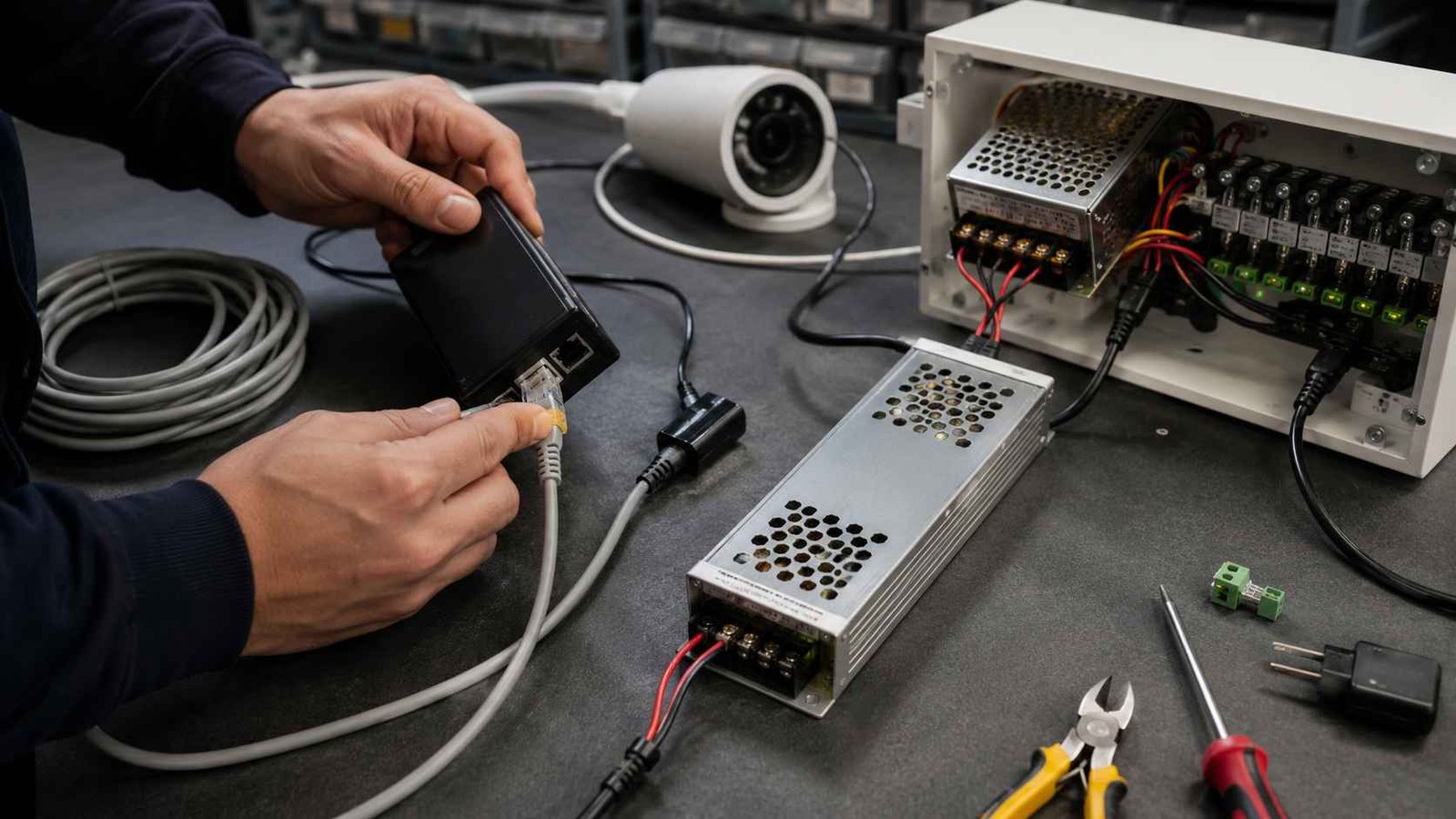
Testing focused on the areas most likely to affect real use: charging compatibility, thermal behavior, cable durability, safety preparation and production repeatability.
| Testing Item | Review Focus | Why It Matters |
|---|---|---|
| PD compatibility | Charging negotiation with laptops, tablets and phones | Confirms stable use across common devices |
| Full-load operation | Output stability and case temperature under defined load | Checks whether the charger can handle practical use |
| Retractable cable cycling | Return force, stop position and contact stability | Verifies the mechanical part of the product |
| Connector and cable stress | Cable outlet, bending point and strain relief | Reduces failure risk during repeated use |
| Pre-compliance review | EMI, safety spacing and filtering preparation | Reduces formal testing and redesign risk |
| Packaging check | Plug version, label, manual and carton marking | Prevents mixed-version shipment problems |
The samples were tested with different device types to review charging negotiation and fallback behavior. This was important because a PD charger may perform well with one device but show unstable behavior with another if the protocol or load transition is not handled properly.
The retractable cable module was also tested repeatedly. The focus was not only whether the cable could retract, but whether the return force remained stable, whether the cable stopped at the expected position and whether the electrical contact stayed reliable after repeated operation.
7. Pilot Run and Production Control
After prototype adjustment, a pilot run was used to check whether the design could be assembled consistently. For a retractable charger, production control is more complex than for a standard fixed-cable or detachable-cable charger because the cable module, housing assembly and charging circuit must fit together accurately.
The pilot run focused on:
- Incoming inspection for charger components and cable modules
- Assembly fit between PCB, housing and retractable cable structure
- PD output test for each finished unit
- Full-load or sampling aging test according to production requirement
- Retractable cable pull-and-return function check
- Visual inspection for housing, cable outlet and plug area
- Label, market version and packaging verification
This stage helped confirm whether the sample design was suitable for repeat production. A sample that works in the lab is not enough. The design also needs to be practical for assembly workers, inspection staff and packing control.
8. Plug Version, Label and Packaging Confirmation
For export charger projects, packaging is not a minor detail. The charger body, plug version, label, manual, warning information and carton marking must match the destination market and customer order plan.
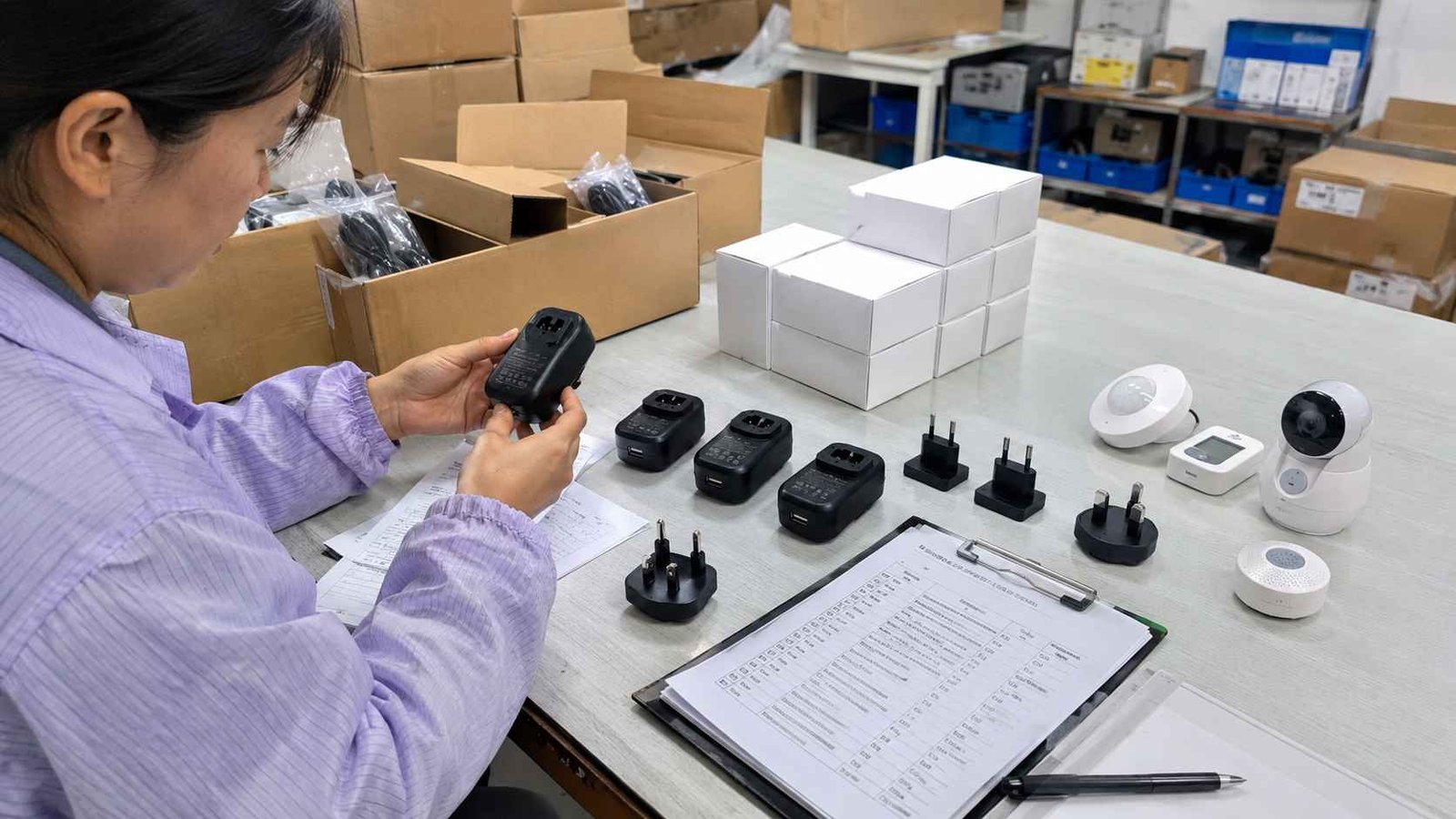
The buyer required a private label and market-specific packaging arrangement. In similar export projects, an interchangeable plug power adapter structure may also be considered when one adapter platform needs to support several regions, but the plug version must still match the product rating, housing structure and certification scope.
Before shipment preparation, the project team confirmed:
- Product model and output marking
- Plug version and market allocation
- Private label artwork
- Certification and warning information on label
- User manual or instruction insert
- Retail box or neutral box layout
- Carton marking and SKU identification
- Packing method to protect the retractable cable structure
For multi-market products, this step helps avoid a common problem: the charger is electrically correct, but the wrong plug, label or packaging version is packed for the wrong destination.
9. Project Result
After prototype adjustment and pilot-run confirmation, the charger configuration was approved for the customer’s launch plan. The final project result was not based on one single specification such as 65W output. Approval depended on a combination of charging stability, cable operation, thermal behavior, version control and packaging readiness.
The project gave the buyer a launch-ready 65W retractable PD charger configuration with defined plug versions, private label packaging and production inspection points. More importantly, the development process clarified the areas that must be controlled in future repeat orders: cable module consistency, PD output testing, thermal performance, label version and packing accuracy.
10. What Buyers Should Learn from This Case
A 65W retractable USB-C PD charger should not be evaluated like a standard charger with a loose cable. The retractable design adds mechanical requirements, while 65W output adds thermal and compliance requirements. Buyers should confirm these details before sample approval:
| Item to Confirm | Why It Matters |
|---|---|
| PD output profiles | Determines compatibility with laptops, tablets and phones |
| PPS requirement | Important for some mobile devices and charging behavior |
| Retractable cable length | Affects user experience and internal structure |
| Cable return force | Affects durability and daily operation feel |
| Housing size | Must balance appearance, assembly and heat dissipation |
| Full-load temperature | Critical for 65W charger reliability |
| Plug version | Needed for different export markets |
| Certification target | Affects design, label and documentation |
| Packaging plan | Prevents version confusion and shipment errors |
This case shows that early specification alignment can reduce project risk in a custom power adapter project, especially when charging performance, mechanical structure, certification and packaging must be confirmed together.
Conclusion
This project shows that a custom 65W USB-C PD retractable charger should be developed through both electrical and mechanical review. Output wattage alone is not enough. The buyer and manufacturer must confirm PD compatibility, cable durability, enclosure temperature, plug version, label design, certification preparation and packaging control before moving into bulk production.
Macable supports custom USB-C PD charger projects with retractable cable design, plug version planning, sample testing, private label packaging and OEM/ODM production coordination. Buyers can send output requirements, cable length, plug type, target market, certification needs and packaging plan for project evaluation and quotation.
11. FAQ
What makes a retractable PD charger different from a regular PD charger?
A retractable PD charger includes a built-in cable module, so it must be tested for both electrical charging performance and mechanical cable durability. Cable return force, bending radius, stop position and strain relief become important selection points.
Why is thermal design important for a 65W charger?
A 65W charger can generate significant heat under continuous load, especially when charging laptops or tablets. The PCB layout, housing size, internal heat path and component spacing must be reviewed together.
Does a 65W charger need PD 3.1?
Not always. Many 65W chargers can be designed around USB-C PD profiles with PPS support depending on the application. The exact PD requirement should be confirmed according to the target devices and market positioning.
What should be tested before approving a retractable charger sample?
Buyers should test PD negotiation, full-load operation, case temperature, cable retraction, cable outlet strain relief, plug fit, label accuracy and packaging version before approving the sample.
Why should EMI be checked before formal certification?
Early pre-compliance review can identify filtering or layout issues before formal submission. This reduces the chance of late-stage redesign and launch delay.
What information should buyers provide for a custom 65W PD charger project?
Buyers should provide output requirements, target devices, cable length, retractable design preference, plug type, housing size target, certification requirements, label design, packaging plan and estimated order quantity. These details help confirm whether the project should use a standard power adapter platform or a customized charger structure.
Can a retractable cable charger be customized for different markets?
Yes. Plug type, label, packaging, manual language and compliance documents can be prepared according to the target market. Market version control should be confirmed before pilot production.
What is the biggest risk in a retractable charger project?
The biggest risk is treating it like a normal charger. The retractable cable module adds mechanical durability requirements, while the 65W output adds thermal and compliance requirements. Both sides must be reviewed together.