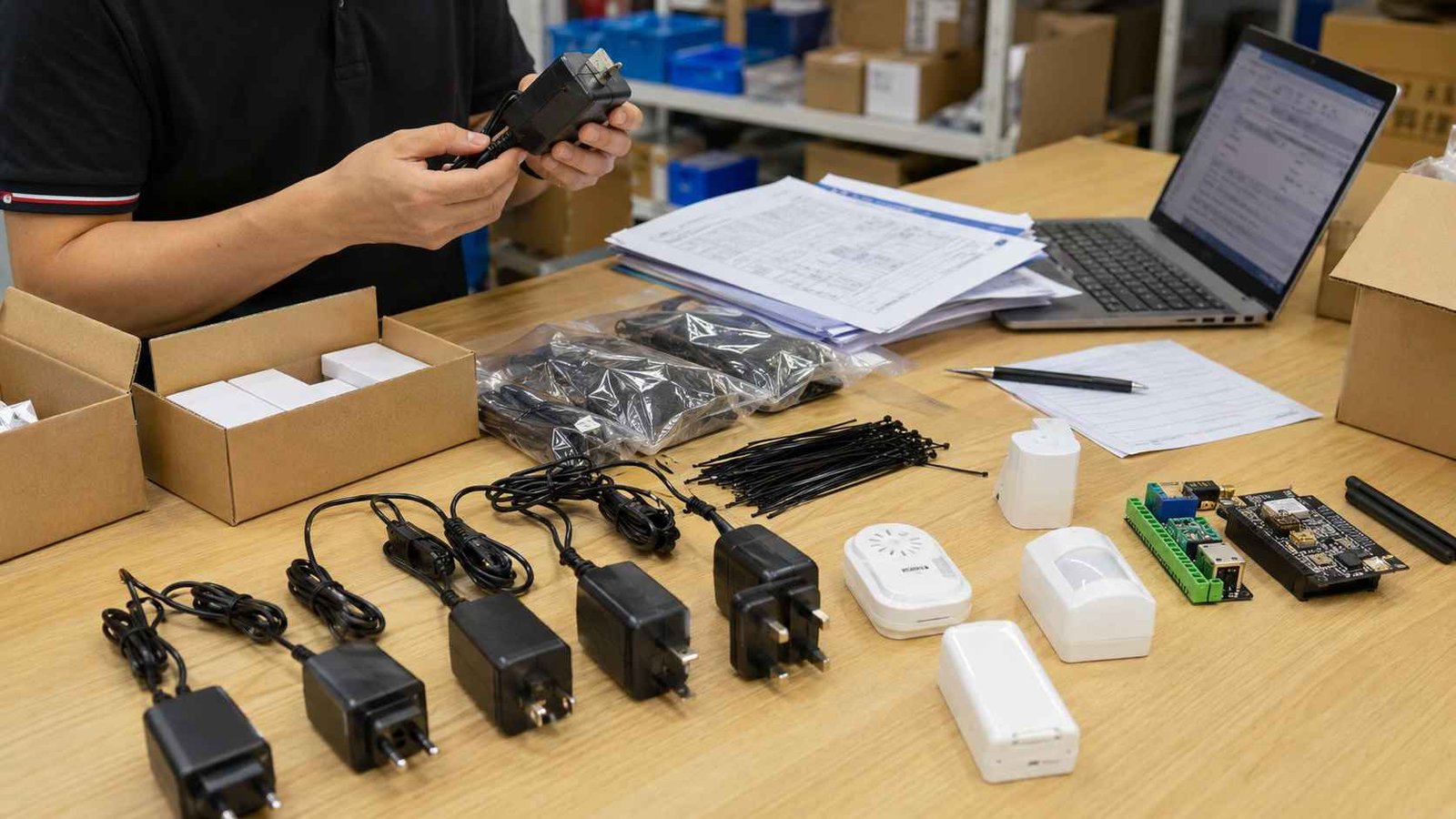


A 5V 2A power adapter is widely used for small electronic devices, network equipment, smart home products, sensors, handheld terminals and low-power control modules. For brands and OEM buyers selling into multiple markets, the adapter is not only a power accessory. It affects device reliability, plug compatibility, certification review, packaging design, after-sales replacement and SKU management.
An interchangeable plug power adapter can reduce the need to stock separate EU, US, UK and AU versions. However, the plug-swapping structure must be checked carefully. A qualified adapter should provide stable 5V output, enough current margin, safe plug locking, suitable connector design, proper efficiency performance and the required documents for the destination market.
This guide explains how to evaluate a 5V 2A interchangeable plug power adapter before sample approval or bulk sourcing.
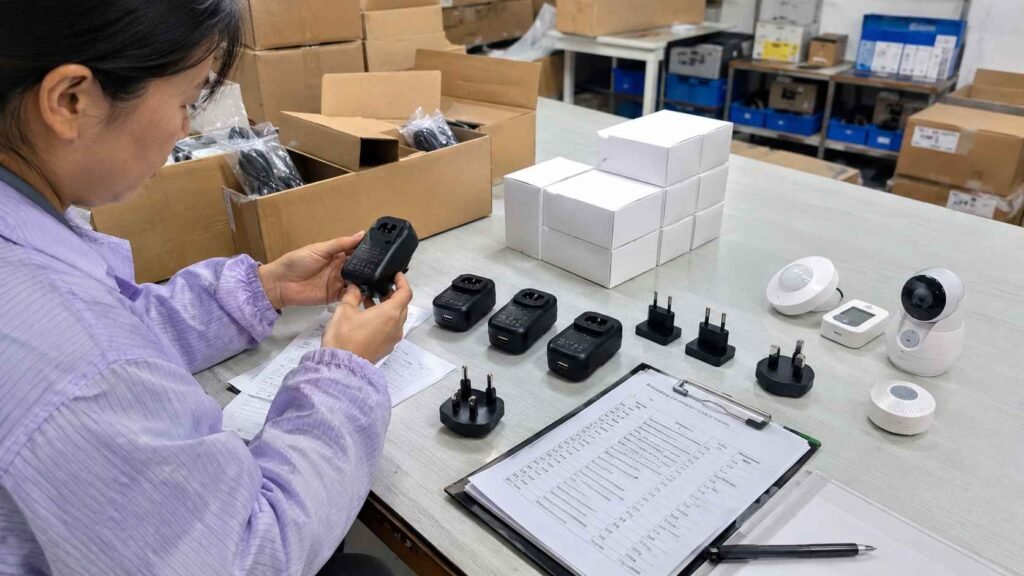
Table of Contents
- 1. Why 5V 2A is common for small electronic devices
- 2. When an interchangeable plug adapter is the better choice
- 3. Confirm voltage, current and real load behavior
- 4. Typical applications for 5V 2A adapters
- 5. Check the interchangeable plug system carefully
- 6. Confirm output connector, polarity and cable details
- 7. Review efficiency, no-load power and heat performance
- 8. Confirm certification and export market requirements
- 9. OEM/ODM details before sample approval
- 10. Common sourcing mistakes
- 11. Final procurement checklist
- 12. FAQ
1. Why 5V 2A is common for small electronic devices
5V is one of the most common DC output voltages for small electronic products. Many devices use 5V input because it is suitable for low-power circuits, USB-related designs, communication modules, control boards and smart device accessories. A 5V 2A adapter provides up to 10W of output power, which is enough for many compact devices without creating an oversized adapter structure.
However, buyers should not select a 5V 2A adapter only because the device label says “5V.” The actual load current, startup behavior, connector type, cable length and target market compliance still need to be confirmed. A device that normally draws 0.8A may briefly require higher current during startup, wireless transmission, relay switching or LED activation.
For external low-voltage devices, a suitable power adapter should be evaluated by output stability, connector matching, plug type, efficiency and certification, not by output voltage alone.
2. When an interchangeable plug adapter is the better choice
An interchangeable plug adapter is useful when the same device needs to be sold into different markets. Instead of preparing separate fixed-plug models for Europe, North America, the United Kingdom, Australia or other regions, buyers can use one adapter platform with different plug heads.
This can simplify inventory and reduce SKU pressure, especially for export electronics, online retail brands, distributors and OEM projects. But the design must be reliable. The plug head should lock firmly, maintain stable electrical contact and meet the mechanical requirements of the destination market.
| Adapter Type | Suitable Use | Main Consideration |
|---|---|---|
| Fixed plug adapter | Single-market products or stable regional sales | Lower complexity, but more SKUs for different countries |
| Interchangeable plug adapter | Multi-market export electronics and OEM projects | Plug locking strength, safety approval and packaging control |
| Desktop adapter | Higher power devices or products needing longer AC cable flexibility | Larger size, separate AC cord, better placement flexibility |
3. Confirm voltage, current and real load behavior
The output voltage must match the device requirement. A 5V device should not be powered by a 6V, 9V or 12V adapter unless the device specification clearly supports that input range. Incorrect voltage can damage the device or shorten its service life.
Current works differently. A 5V 2A adapter does not force 2A into the device. The device draws what it needs, as long as the voltage is correct and the adapter can provide enough current. A 5V 2A adapter can usually power a 5V device that draws 1A, but a 5V 1A adapter may not be reliable for a device that reaches 1.5A or 2A during peak operation.
| Electrical Item | What to Confirm | Why It Matters |
|---|---|---|
| Output voltage | Stable 5V DC output | Wrong voltage can damage the device |
| Rated current | 2A output capacity or higher if required | Insufficient current causes reset or voltage drop |
| Peak current | Startup, wireless transmission or load switching | Prevents intermittent failure |
| Output wattage | 5V × 2A = 10W | Useful for model comparison |
| Ripple and noise | Check for sensitive electronics and communication devices | Poor output quality may cause unstable operation |
For continuous operation, the adapter should not be selected too close to the actual load. If the device normally draws 1.8A, a 5V 2A adapter has very little margin. In that case, the project should be reviewed carefully, or a higher-current model may be more reliable.
4. Typical applications for 5V 2A adapters
A 5V 2A interchangeable plug adapter is commonly used for compact electronic products that need global plug compatibility. Typical applications include:
- Wi-Fi routers and small access points
- IoT gateways and smart home hubs
- Security sensors and compact alarm accessories
- Mini cameras and low-power monitoring devices
- Streaming media players and set-top boxes
- POS accessories and handheld terminals
- Embedded control boards and small electronic modules
- USB-powered low-voltage devices requiring stable 5V input
For security-related devices, the adapter should be checked together with cable length, connector type and peak current. Some low-power security devices can use a 5V adapter, while larger CCTV, access control or multi-device installations may need a dedicated security power supply or a PoE-based design.
5. Check the interchangeable plug system carefully
The plug system is the core feature of an interchangeable adapter. Buyers should not evaluate it only by appearance. The plug head should slide, lock or clip into place firmly, without looseness during normal use. It should also be difficult to remove accidentally when the adapter is plugged into a wall outlet.
For export projects, the plug options should be confirmed according to the destination markets. Common plug heads include EU, US, UK, AU and other regional types. If the same adapter is sold into several regions, packaging should clearly match the plug combination included in each shipment.
| Plug Detail | What to Check | Risk if Ignored |
|---|---|---|
| Plug locking | Firm attachment and safe removal force | Loose contact or unsafe use |
| Regional plug type | EU, US, UK, AU or other market requirement | Wrong product for destination country |
| Mechanical fit | Plug head aligns correctly with adapter body | Poor appearance or unstable connection |
| Packaging match | Correct plug heads included for each order | Distribution and after-sales problems |
| Safety approval | Plug structure covered by required certification | Compliance risk in regulated markets |
6. Confirm output connector, polarity and cable details
Many samples fail because the electrical rating is correct but the connector is wrong. A 5V 2A adapter may meet the device’s power demand, but it cannot be approved if the DC plug does not fit the enclosure, the cable is too short or the polarity is incorrect.
Before sample confirmation, check:
- Output type: USB-A, USB-C, DC barrel plug or customized connector
- DC plug size, such as 5.5 × 2.1 mm, 3.5 × 1.35 mm or other required dimensions
- Center-positive or center-negative polarity
- Cable length and wire gauge
- Straight or right-angle connector
- Cable material, flexibility and strain relief
- Connector fit with the final device housing
Connector confirmation should be done with physical device samples. A small difference in plug length or outer diameter can cause unstable contact, even when the adapter output is correct.
7. Review efficiency, no-load power and heat performance
For export electronics, adapter efficiency is part of product compliance and user experience. Buyers should review average active efficiency, no-load power consumption and thermal performance under real working conditions.
No-load power consumption matters because many small devices remain plugged in for long periods. Even when the device is not actively working, the adapter should not waste unnecessary standby power. Heat should also be checked, especially when the adapter is used behind furniture, near network equipment or in a warm environment.
A practical sample test should include:
- No-load power measurement
- Full-load operation test
- Case temperature check after several hours
- Voltage stability during startup and peak load
- Output ripple and noise check for sensitive devices
- Plug-head stability after repeated installation and removal
8. Confirm certification and export market requirements
For a 5V 2A interchangeable plug power adapter, certification should be confirmed before sample approval, not after bulk production. The required documents depend on the destination market, product type and buyer requirements.
Common requirements may include CE, UL, FCC, UKCA, RoHS, IEC 62368-1, EMC test reports, energy efficiency information and related label requirements. If the adapter is exported with a finished device, the adapter documents should match the final product’s compliance file.
Buyers should pay attention to whether the interchangeable plug structure is included in the certification scope. It is not enough to approve the adapter body only if the plug heads are part of the final shipped product.
| Market / Requirement | What to Confirm | Procurement Risk |
|---|---|---|
| EU market | CE, EMC, RoHS, Ecodesign-related efficiency information | Label or documentation mismatch |
| U.S. market | UL or ETL where required, FCC, Level VI efficiency | Market entry or buyer audit issue |
| UK market | UKCA and UK plug requirement | Wrong plug or label information |
| Multi-market order | Correct plug heads, label versions and packaging versions | SKU confusion or incorrect shipment |
9. OEM/ODM details before sample approval
For brand owners, importers and device manufacturers, a 5V 2A interchangeable plug adapter is often part of a larger product package. The adapter must match the device, packaging, user manual, label artwork and compliance file.
Before confirming the sample, prepare the following OEM/ODM details:
- Adapter housing color and surface finish
- Private label, neutral label or buyer brand label
- Model number and output marking
- Plug heads required for each market
- Output connector and cable length
- Packaging method and accessory layout
- User manual or warning label language
- Carton marking and barcode requirements
- Sample quantity and estimated annual order quantity
These details should be confirmed before certification review and bulk production. Changing the plug set, cable, label or packaging after approval can create delays and additional testing cost.
10. Common sourcing mistakes
| Mistake | Possible Result | Better Practice |
|---|---|---|
| Choosing only by 5V 2A rating | Connector, plug or certification mismatch | Check the complete adapter specification |
| Ignoring peak current | Device reset or unstable startup | Test under real load condition |
| Using a loose interchangeable plug design | Unsafe contact or customer complaints | Check locking strength and repeated-use stability |
| Approving drawings without physical connector testing | Sample cannot fit the device | Confirm with actual product samples |
| Checking certificates after placing a bulk order | Shipment delay or compliance risk | Review documents before sample approval |
| Using one label for all markets | Incorrect safety marks or language | Prepare market-specific label versions if needed |
11. Final procurement checklist
Before requesting a quotation, buyers should provide complete information instead of asking only for “5V 2A adapter price.” A clear specification helps the supplier recommend the correct model and reduces repeated sample changes.
| Information to Provide | Example Details |
|---|---|
| Device application | Router, gateway, sensor, camera, POS accessory, smart home device or control board |
| Output requirement | 5V 2A, USB output or DC connector output |
| Input range | 100–240V AC or specific regional input requirement |
| Plug requirement | EU, US, UK, AU or interchangeable plug set |
| Connector | USB-A, USB-C, DC barrel plug, polarity and cable length |
| Compliance target | CE, UL, FCC, UKCA, RoHS, IEC 62368-1, Level VI or EU Ecodesign requirement |
| Label and packaging | Brand label, neutral label, model number, barcode and manual language |
| Order plan | Sample quantity, estimated annual quantity and OEM/ODM customization needs |
Conclusion
A 5V 2A interchangeable plug power adapter should be selected from the full export application, not from voltage and current alone. Buyers should confirm the real device load, plug-head structure, connector type, cable length, efficiency performance, heat behavior, certification documents, label design and packaging plan before approving samples.
For multi-market electronics, an interchangeable plug adapter can reduce SKU complexity and make distribution easier, but only when the plug system, safety approval and shipped accessories are controlled correctly. A well-selected adapter helps improve product reliability, reduce after-sales issues and support smoother export compliance.
Macable supplies 5V 2A interchangeable plug power adapters for routers, smart home devices, IoT gateways, security sensors, compact electronic products and OEM export projects. Buyers can send the application details, plug type, output connector, cable requirement, compliance target and target market information for model recommendation and OEM/ODM quotation.
12. FAQ
What devices commonly use a 5V 2A power adapter?
Common applications include Wi-Fi routers, smart home hubs, IoT gateways, mini cameras, security sensors, POS accessories, small control boards and other low-voltage electronic devices.
Is a 5V 2A adapter safe for a device that only needs 1A?
Yes, if the voltage is correct and the connector and polarity match. The device draws only the current it needs. The adapter’s current rating should be equal to or higher than the device requirement.
Why choose an interchangeable plug adapter instead of fixed plug versions?
An interchangeable plug adapter can reduce SKU quantity for multi-market sales. One adapter body can be paired with different plug heads for different regions, which helps simplify inventory and packaging planning.
What should be checked in the interchangeable plug structure?
Check plug locking strength, electrical contact stability, repeated removal and installation, regional plug compatibility, safety approval scope and correct plug packaging for each shipment.
What certifications are important for 5V 2A export adapters?
Common requirements may include CE, UL, FCC, UKCA, RoHS, IEC 62368-1, Level VI efficiency or EU Ecodesign-related information, depending on the destination market and buyer requirements.
Does the DC connector matter if the voltage is correct?
Yes. The adapter cannot be used if the DC plug size, polarity, cable length or output connector type does not match the device. Connector details should be confirmed with physical samples.