

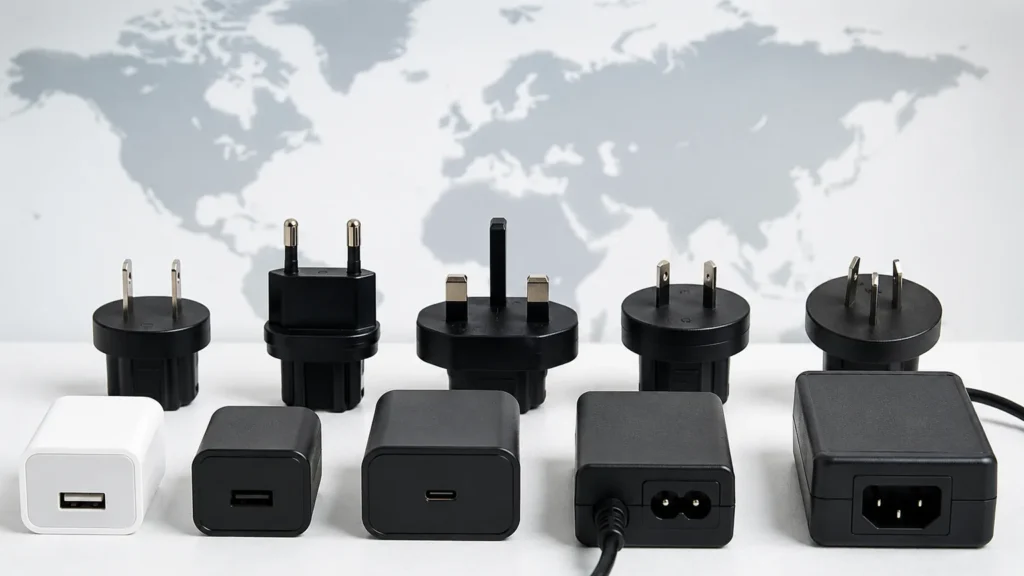
If you are using or selling electronic devices in another country, the right power adapter depends on three things: plug type, local voltage, and your device input rating.
For most modern phones, laptops, routers, small electronics and chargers, the label often says Input: 100–240V, 50/60Hz. If your adapter has this wide input rating, you usually only need the correct plug shape for the destination country. If the adapter is marked 110V only or 220V only, you may need a voltage converter or a different power supply.
This guide explains what power adapter is needed for different countries, including Japan, Italy, Mexico, Canada, China, the UK, Europe, Australia, Brazil, Thailand, the Philippines and more. It also explains what OEM buyers should confirm before ordering country-specific power adapters for global products.
Quick Answer: How to Know Which Power Adapter You Need
The fastest way is to check the label on your existing charger or power supply.
If the label says “Input: 100–240V, 50/60Hz”, the adapter can usually work with most country voltage systems. You still need the correct wall plug type.
If the label says “Input: 110V only” or “120V only”, do not plug it directly into 220–240V countries without a suitable converter or replacement power adapter.
If the label says “Input: 220–240V only”, it may not work correctly in 100–120V countries such as the United States, Canada, Japan or Mexico.
For electronic devices that use DC input, such as 5V 2A, 9V 2A, 12V 1A or 24V 1.5A, the replacement adapter must also match the output voltage, current, connector size, cable length and polarity. The plug shape alone is not enough.
Power Adapter, Plug Adapter and Voltage Converter: What Is the Difference?
Many people use these terms interchangeably, but they are different products.
| Item | What It Does | What to Remember |
|---|---|---|
| Plug Adapter | Changes the physical plug shape so it fits another country’s wall outlet. | It does not change voltage. |
| Voltage Converter | Changes voltage, such as 220V to 110V or 110V to 220V. | Used mainly for single-voltage appliances. |
| AC/DC Power Adapter | Converts AC mains power into DC output for electronic devices. | It must match input voltage, output voltage, current, connector and safety requirements. |
For most electronics brands and OEM buyers, the real task is not just finding a travel plug. It is choosing a reliable AC/DC power adapter that matches the target country, product application and compliance requirements.
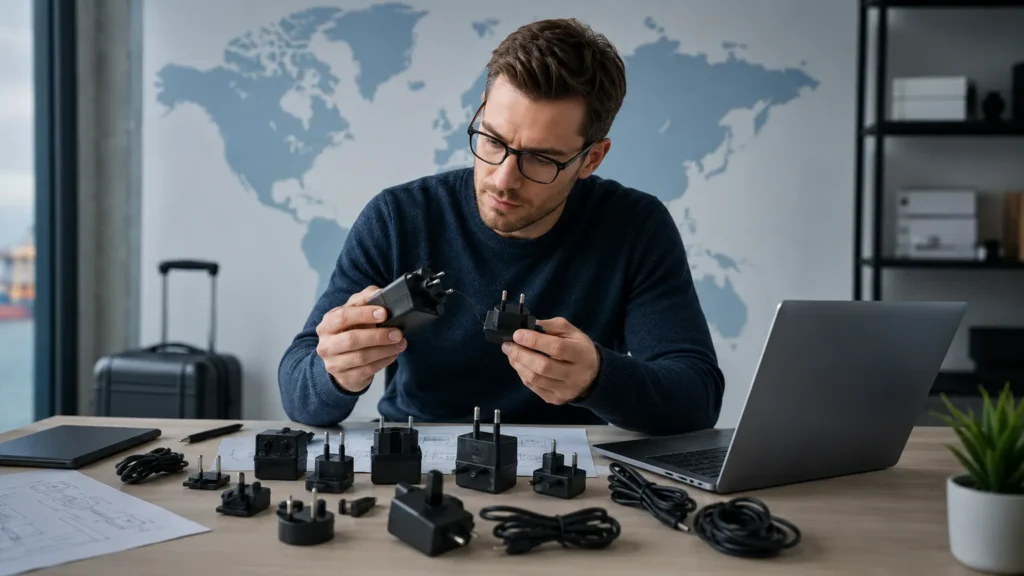
Country Power Adapter Quick Reference
The table below gives a practical country-by-country reference. Local sockets may vary in old buildings, hotels, factories and special installations, so final plug type and certification requirements should still be confirmed before mass production or shipment.
| Country / Region | Common Plug Type | Typical Voltage | Do You Need an Adapter? |
|---|---|---|---|
| United States | Type A / B | 120V, 60Hz | Use US plug. Check voltage if coming from 220–240V markets. |
| Canada | Type A / B | 120V, 60Hz | Similar to US plug system. |
| Mexico | Type A / B | Usually around 127V, 60Hz | US-style plugs may fit, but voltage and certification still matter. |
| Japan | Type A / B | 100V, 50/60Hz | US-style plugs may fit, but Japan uses lower voltage. |
| Taiwan | Type A / B | 110V, 60Hz | Similar plug family to North America. |
| United Kingdom | Type G | 230V, 50Hz | UK plug required for most products. |
| Ireland | Type G | 230V, 50Hz | Similar to UK plug system. |
| Singapore | Type G | 230V, 50Hz | UK-style plug commonly used. |
| Malaysia | Type G | 230–240V, 50Hz | UK-style plug commonly used. |
| Hong Kong | Type G | 220V, 50Hz | UK-style plug commonly used. |
| France | Type C / E | 230V, 50Hz | EU plug or France-compatible grounded plug may be needed. |
| Germany | Type C / F | 230V, 50Hz | Schuko-compatible plug often required for grounded devices. |
| Spain | Type C / F | 230V, 50Hz | EU plug usually needed. |
| Portugal | Type C / F | 230V, 50Hz | EU plug usually needed. |
| Greece | Type C / F | 230V, 50Hz | EU plug usually needed. |
| Italy | Type C / F / L | 230V, 50Hz | Italy may require Type L depending on socket and product type. |
| Switzerland | Type J | 230V, 50Hz | Swiss plug should be confirmed, especially for grounded products. |
| Denmark | Type C / F / K | 230V, 50Hz | Check grounded plug requirement carefully. |
| China | Type A / C / I | 220V, 50Hz | China plug and local compliance should be confirmed. |
| Australia | Type I | 230V, 50Hz | AU plug required. |
| New Zealand | Type I | 230V, 50Hz | Similar plug family to Australia. |
| Thailand | Type A / B / C / O | 230V, 50Hz | Plug type can vary; confirm before ordering. |
| Vietnam | Type A / C / F | 220V, 50Hz | Plug type may vary by location and product channel. |
| Philippines | Type A / B / C | 230V, 60Hz | Plug may look US-style, but voltage is different. |
| South Korea | Type C / F | 220V, 60Hz | EU-style plug shape, but 60Hz frequency. |
| India | Type C / D / M | 230V, 50Hz | Confirm exact plug type for the project or sales channel. |
| Israel | Type H | 230V, 50Hz | Israel-specific plug should be checked. |
| Brazil | Type N | 127V or 220V, 60Hz | Use wide input adapters because voltage can vary by region. |
| Argentina | Type C / I | 220V, 50Hz | Type I details should be confirmed before production. |
| Peru | Type A / B / C | 230V, 60Hz | Plug types vary; wide input is recommended. |
| South Africa | Type M / N | 230V, 50Hz | Confirm whether Type M or Type N is needed. |
| Egypt | Type C / F | 230V, 50Hz | EU-style plug is commonly used. |
| Morocco | Type C / E | 220–230V, 50Hz | EU-style plug is commonly used. |
What Power Adapter Do I Need for Japan?
Japan commonly uses Type A and Type B plugs. The important difference is voltage: Japan usually uses 100V, which is lower than the 120V system used in the United States and Canada.
If your charger or adapter says 100–240V, 50/60Hz, it can usually accept Japan’s voltage. You may only need the correct plug shape. If your adapter is designed for 120V only, you should not assume it will work normally in Japan.
For OEM buyers selling electronic devices in Japan, confirm the AC plug, input rating, label format and required safety documents before sample approval. Japan is not just a “US plug” market.
What Power Adapter Do I Need for Italy?
Italy uses around 230V, 50Hz. Common plug types include Type C, Type F and Type L. This makes Italy slightly different from a simple “Europe plug” answer.
For small ungrounded chargers, a Europlug-style adapter may work in many sockets. For grounded equipment, higher-power adapters, LED products or industrial devices, buyers should confirm whether Type L or another Italy-compatible plug is required.
If you are selling one product across Italy, Germany, France and Spain, do not only write “EU plug” in the purchase order. Confirm whether one plug version can cover all target countries, or whether Italy needs a separate configuration.
What Power Adapter Do I Need for Mexico?
Mexico commonly uses Type A and Type B plugs, similar to the United States and Canada. The voltage is often around 127V, 60Hz.
For travelers from the United States, many plugs may physically fit. For travelers from Europe, the UK, Australia or China, a plug adapter may be needed. For electronic products, the adapter must also support the local input voltage and meet the required market standards.
For OEM power adapter orders, Mexico should not be treated as only a US extension. Buyers should confirm plug type, label language, packaging and certification needs with the local importer or distributor.
What Power Adapter Do I Need for Europe?
Europe is one of the most misunderstood regions for power adapters. Many mainland European countries use 230V, 50Hz, but plug types are not identical everywhere.
France commonly uses Type C and Type E. Germany, Spain, Portugal, Greece and the Netherlands commonly use Type C and Type F. Italy may require Type L. Switzerland uses Type J. The UK and Ireland use Type G, which is completely different from most mainland European plugs.
For travel, this means a single “Europe adapter” may not cover every country. For OEM product sales, this means the buyer should provide a clear country list instead of only saying “Europe market.”
What Power Adapter Do I Need for the UK?
The United Kingdom uses the Type G plug with around 230V, 50Hz. Type G plugs are also common in Ireland, Singapore, Malaysia and Hong Kong.
If your device has a US, EU, AU or China plug, you will usually need a UK plug adapter or a dedicated UK power adapter. For OEM orders, the UK plug version should be confirmed together with fuse structure, label information and market documentation.
What Power Adapter Do I Need for China?
China commonly uses 220V, 50Hz. Plug types can include Type A, Type C and Type I. Some sockets may accept more than one plug shape, but that does not remove the need to check voltage and compliance.
For products sold in China, buyers should confirm the China plug, Chinese label requirements and applicable certification needs before shipment. For products manufactured in China but exported overseas, the adapter should be configured according to the destination market, not only the production country.
What Power Adapter Do I Need for Australia and New Zealand?
Australia and New Zealand commonly use the Type I plug with around 230V, 50Hz. If your device uses a US, EU or UK plug, you will need an AU/NZ plug adapter or a dedicated AU plug power adapter.
For OEM buyers, Australia and New Zealand often require careful attention to plug structure, label requirements and local approval planning. If the same product is also sold in China or Argentina, do not assume every Type I market has identical requirements.
What Power Adapter Do I Need for Brazil?
Brazil commonly uses Type N plugs, and voltage may be 127V or 220V depending on the region. This makes Brazil one of the markets where wide input power adapters are especially useful.
If a product will be sold in several Brazilian cities, using a 100–240VAC, 50/60Hz adapter can reduce voltage mismatch risk. Buyers should still confirm plug type, certification, label language and importer information before production.
Why Wide Input Power Adapters Are Better for Global Products
For global electronics sales, a power adapter with 100–240VAC, 50/60Hz input is usually more practical than a single-voltage adapter. It allows the same adapter platform to support both 100–120V countries and 220–240V countries.
This is useful for products such as:
- routers and networking devices;
- smart home products;
- IoT gateways and sensors;
- security cameras and access control devices;
- portable electronics;
- USB chargers and USB-C PD chargers;
- LED lighting products;
- industrial control devices;
- small medical and beauty devices.
However, wide input does not mean one adapter automatically fits every country. The AC plug, DC connector, label, packaging and certification still need to match the destination market.
When an Interchangeable Plug Power Adapter Is the Better Choice
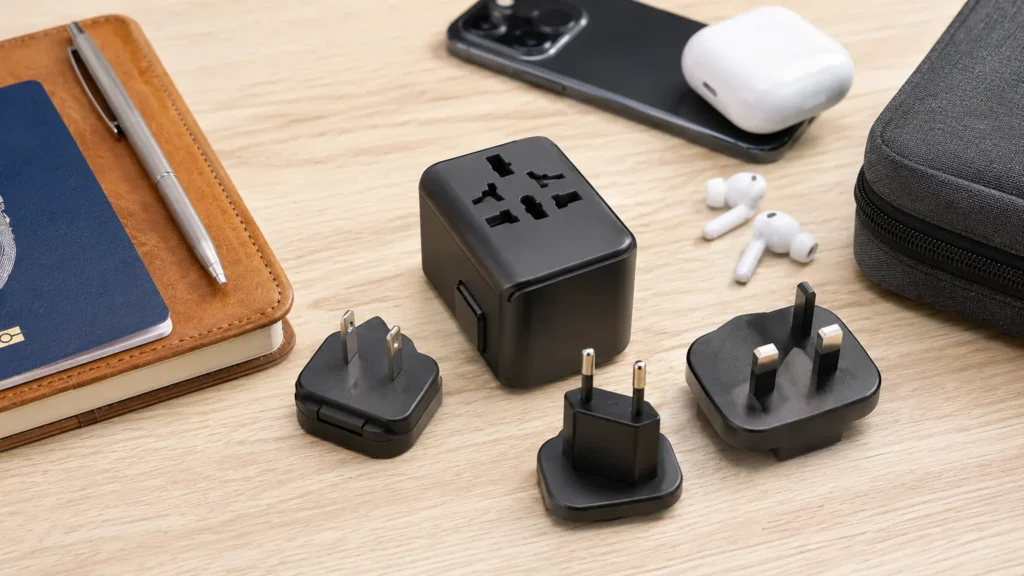
An interchangeable plug power adapter is useful when the same device is sold in multiple countries. Instead of producing completely separate US, EU, UK and AU adapter models, buyers can use one adapter body with different replaceable AC plug heads.
This can help reduce SKU complexity, simplify inventory planning and make global packaging easier. For example, a smart home device may require the same 5V 2A DC output in every country, but the AC plug version may change for the United States, Europe, the UK, Australia, Japan or other markets.
Macable’s 5V 2A interchangeable plug power adapter is a useful reference for buyers comparing multi-country adapter configurations for export electronics.
Before choosing an interchangeable plug adapter, check these points:
- whether the plug head locks firmly into the adapter body;
- whether each plug head meets the target country’s pin structure;
- whether the adapter body supports the required input voltage range;
- whether the output voltage and current match the device;
- whether the safety documents cover the plug versions being sold;
- whether the label and packaging match each target market.
Fixed Plug or Interchangeable Plug: Which Should OEM Buyers Choose?
Both options can be correct. The better choice depends on the sales model, country list, order quantity and compliance plan.
| Adapter Type | Best For | Buyer Consideration |
|---|---|---|
| Fixed Plug Power Adapter | Single-country orders, stable market demand, lower plug-change complexity. | Each country may need a separate SKU and packaging version. |
| Interchangeable Plug Power Adapter | Multi-country sales, export kits, distributors, retail bundles and sample programs. | Plug locking structure, certification coverage and packaging design must be checked carefully. |
| Desktop Adapter with AC Cord | Higher-power devices, medical equipment, LED systems, industrial control products. | AC cord version can be changed by country, but safety approval must still match the final market. |
What OEM Buyers Should Confirm Before Ordering Country Power Adapters
For B2B sourcing, the country plug is only one part of the specification. A complete power adapter request should include the following details.
1. Target Countries
List exact countries instead of broad regions. “Europe” is not enough. Germany, Italy, Switzerland and the UK may require different plug solutions. “Asia” is also too broad because Japan, China, Korea, Singapore, India and Thailand have different plug and voltage situations.
2. Input Rating
For export products, 100–240VAC, 50/60Hz input is usually preferred. It helps one adapter platform support more countries and reduces the risk of voltage mismatch.
3. Output Voltage and Current
The output must match the device. A 5V product should not be powered by a 12V adapter. A device that normally uses 1A may still need more current during startup, wireless transmission, LED activation or peak operation.
4. Connector and Polarity
For barrel connectors, confirm outer diameter, inner diameter, polarity and cable length. For USB-powered products, confirm whether the product needs USB-A, USB-C or USB-C PD output. Buyers sourcing charging products can also review Macable’s charger and PD charger category for USB charging applications.
5. Product Application
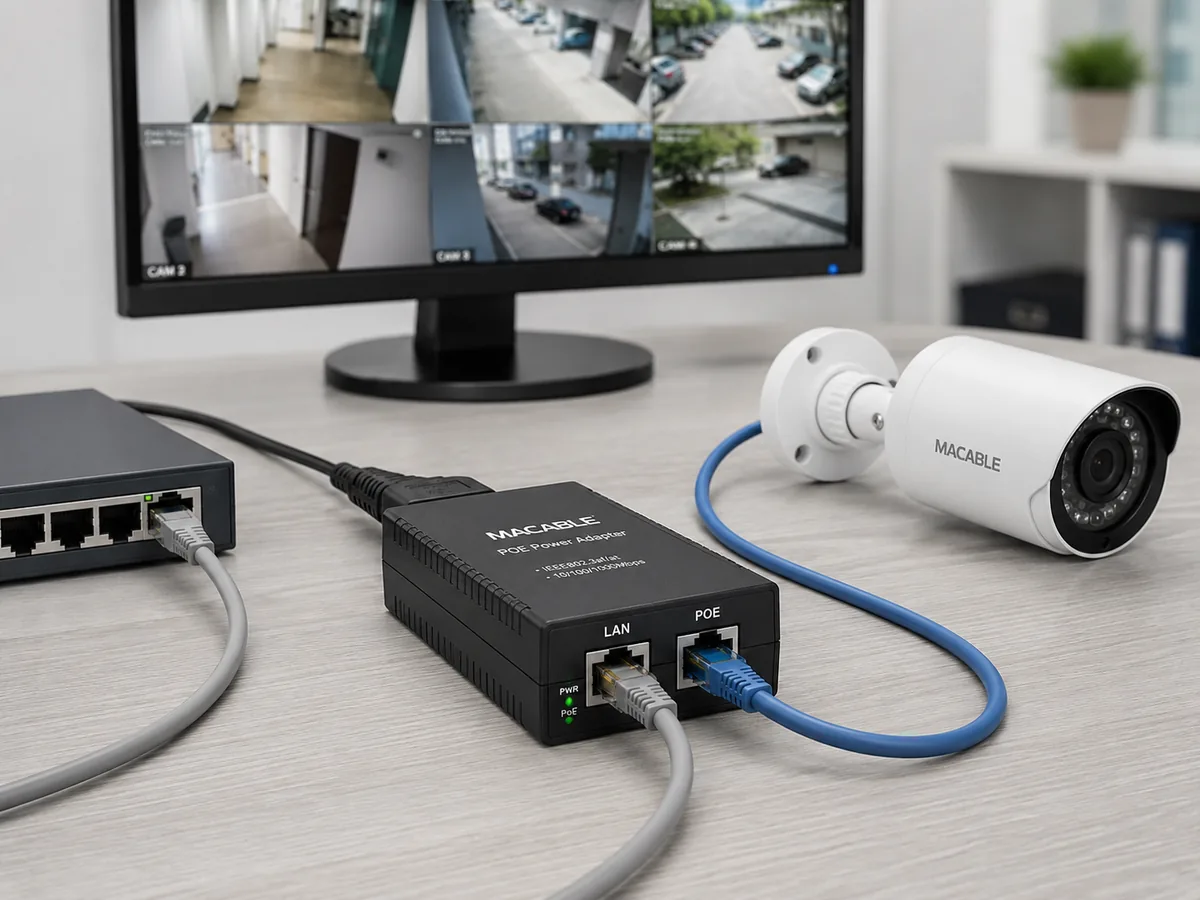
A power adapter for a router is not the same as a charger for mobile electronics, a PoE adapter for IP cameras or an LED driver for lighting systems. Application affects output stability, protection design, cable selection, housing, heat performance and safety review.
For network and security projects, buyers can compare PoE power adapter options. For lighting products, the adapter should be selected according to LED load, working environment and installation method, which is different from ordinary consumer electronics.
6. Certification, Label and Packaging
Different markets may require different safety, EMC, energy efficiency and product labeling requirements. For export orders, confirm the approval marks, model number, input/output information, warning text, importer information, packaging language and user manual before mass production.
Common Sourcing Mistakes to Avoid
Many adapter problems happen because buyers only check the plug shape and ignore the rest of the power supply specification.
- Only checking the plug shape: A plug may fit, but voltage or output rating may still be wrong.
- Using a travel adapter for product sales: Travel adapters are not a complete OEM power solution.
- Assuming all European countries use the same plug: Italy, Switzerland, Denmark and the UK need extra attention.
- Ignoring Brazil’s voltage variation: Brazil may use 127V or 220V depending on the region.
- Using the wrong DC connector: Similar-looking barrel connectors may have different sizes or polarity.
- Confirming certification too late: Certification and label planning should happen before production, not after packaging.
- Choosing current rating too tightly: The adapter should allow enough margin for startup and peak load.
Country Power Adapter Selection Checklist
Before ordering power adapters for different countries, prepare this information for your supplier:
- target country list;
- fixed plug, interchangeable plug or desktop adapter preference;
- input voltage and frequency requirement;
- DC output voltage and current;
- wattage and load margin;
- DC connector size and polarity;
- cable length and cable type;
- housing size and color preference;
- certification and market document requirements;
- label content and packaging format;
- sample quantity and testing plan before bulk order.
Final Recommendation
If you are traveling, check your destination country, plug type and the input label on your charger. If the charger supports 100–240V, 50/60Hz, you usually need only the correct plug adapter. If it is single-voltage, you may need a voltage converter or a different charger.
If you are an electronics brand, distributor, importer or equipment manufacturer, choose the adapter based on the full product and market requirement. The right solution should match the country plug, input voltage, output rating, connector, cable, safety documents, label and packaging.
Macable supplies AC/DC power adapters, interchangeable plug adapters, USB chargers, PD chargers, PoE power adapters, LED driver power supplies and industrial power supply products for OEM and ODM projects. Buyers can send the target country list, output voltage, current, plug type, connector, cable length, label and certification requirements for model selection or custom production discussion.
FAQ
Do I need a power adapter for Japan?
Yes, you may need a plug adapter for Japan if your device does not use Type A or Type B plugs. Japan usually uses 100V power, so you should also check whether your charger supports 100–240V input.
What power adapter do I need for Italy?
Italy uses 230V, 50Hz power and may use Type C, Type F or Type L plugs. For small ungrounded chargers, a European-style plug may work, but grounded products should be checked more carefully.
Do I need a power adapter for Mexico?
Mexico commonly uses Type A and Type B plugs, similar to the United States. The voltage is often around 127V, 60Hz. If your charger supports 100–240V input, you may mainly need the correct plug shape.
Can I use a US power adapter in Europe?
You can use a US power adapter in Europe only if the label says 100–240V, 50/60Hz. If it is 120V only, do not plug it directly into a 230V European outlet without a suitable converter or replacement adapter.
Is a plug adapter the same as a power adapter?
No. A plug adapter only changes the physical plug shape. A power adapter converts AC mains power into DC output for the device. A plug adapter does not change voltage by itself.
What is the best power adapter for global products?
For many global electronics projects, a wide-input AC/DC power adapter with 100–240VAC, 50/60Hz input and country-specific plug options is a practical choice. The final model should still match output voltage, current, connector, certification and packaging requirements.
Why do OEM buyers use interchangeable plug power adapters?
Interchangeable plug power adapters help reduce SKU complexity when the same device is sold in several countries. One adapter body can be matched with different plug heads, such as US, EU, UK and AU versions, if the design and certification support those markets.
Do all European countries use the same power adapter?
No. Many mainland European countries use Type C, E or F plugs, but Italy, Switzerland, Denmark, the UK and Ireland may need different plug solutions. Buyers should confirm the exact country list before ordering.